

Could AI misinformation sway the Scottish election?
Persuasive AI assistants, deepfakes and bots are now commonplace. But could they be used by bad actors to influence Scotland’s elections?
Persuasive AI assistants, deepfakes and bots are now commonplace. But could they be used by bad actors to influence Scotland’s elections?
A well known salmon farming company was told by Scottish Government inspectors to cut lice numbers at three of its sites in Sutherland. It responded by suggesting that other salmon farmers were failing to report lice numbers accurately.
The Ferret visited Poland to visit House 88, the former home of Rudolf Höss, the SS officer who ran the Auschwitz-Birkenau extermination camp. The house is being transformed into a global centre to fight extremism.


A study to determine the impacts of pheasants and red-legged partridges on Scotland’s environment and native species is set to commence this year.
The Game and Wildlife Conservation Trust (GWCT) aims to examine the effects caused by releasing millions of non-native gamebirds each year in rural Scotland to be shot for sport.
A pilot assessment is due to take place this spring in the Cairngorms National Park.
NatureScot recommended research into the impacts of gamebirds in 2023, according to internal communications we obtained via freedom of information.
RSPB Scotland has previously urged the wildlife agency to take action around the release of gamebirds in or around protected areas containing capercaillie, an endangered native bird.
In internal emails, NatureScot highlighted that most existing impact studies have been done in England, where, unlike in Scotland, authorities can regulate the release of gamebirds.
RSPB told The Ferret that such powers are “significantly weaker in Scotland than in other UK countries”.
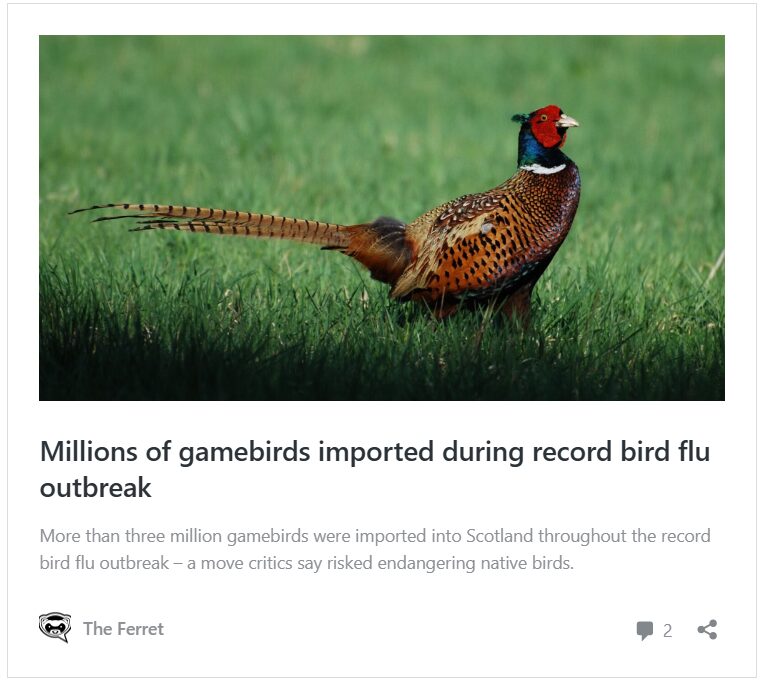
An initial assessment from NatureScot found it ”possible” or “likely” that gamebirds were present in dozens of special protected areas (SPAs) after having been released nearby.
These protected areas contain habitats of native breeding birds including capercaillie, oystercatcher, golden eagle, hen harrier and osprey, but the majority do not require land managers to gain consent in order to release animals.
In England, a licence is required to release gamebirds within 500-metre ‘buffer zones’ surrounding SPAs and special areas of conservation. The UK Government says it is better to “avoid releasing gamebirds wherever possible” from within any protected site.
Asked about the upcoming impact study, RSPB said it was “important that we build understanding of both the numbers and of environmental impacts [of gamebirds] on wildlife habitats at release sites”.
Paul Walton, RSPB Scotland’s head of habitats and species, warned of potential impacts on native animal species, including the potential to pass on disease – particularly bird flu – and the risk of gamebirds attracting more predators, which could also prey on other species.
“RSPB Scotland believes ministers should have the power to regulate releases of gamebirds where environmental harm or disease transfer is occurring or is likely to occur,” he added.
“Such powers are currently significantly weaker in Scotland than in other UK countries.”
A NatureScot spokesperson said: “Currently, there is little evidence to show that gamebirds are causing damage to protected areas in Scotland, but we will continue to monitor the situation closely.”
They claimed discussions about the research had taken place with partner organisations.
A GWCT spokesperson said: “The pilot project to begin looking at the numbers of gamebirds released within the Cairngorms National Park has not yet taken place, but is due to start this spring once the plan for it has been finalised.”
Main image: Agustín Povedano/Flickr


A well known salmon farming company was told by Scottish Government inspectors to cut lice numbers at three of its sites in Sutherland. It responded by suggesting that other salmon farmers were failing to report lice numbers accurately.

The Ferret visited Poland to visit House 88, the former home of Rudolf Höss, the SS officer who ran the Auschwitz-Birkenau extermination camp. The house is being transformed into a global centre to fight extremism.

We visited the Polish city of Krakow ahead of Holocaust Memorial Day which is held to remember the millions murdered by the Nazis – including six million Jews. Krakow's Jewish population was decimated then but the city is now home to one of the fastest-growing Jewish communities in the world.

Political parties have accepted thousands of pounds from lobbyists in recent years. Anti-corruption campaigners claimed donations buy lobby firms “privileged access” to politicians for their wealthy clients.


