A freedom of information response revealed there have been 193 charges in Scotland under the Terrorism Act 2000. The alleged offences link to banned groups like the Ulster Volunteer Force, Ulster Freedom Fighters, the IRA, and neo-Nazi group, National Action.
The number of Scottish terrorism charges in relation to Palestine Action in the last seven months is more than all the other charges put together since the 2000 Terrorism Act came into force, new figures reveal
The Scottish Government’s forestry agency has admitted that red squirrel nests may be “lost” when it cuts down trees, and promised to improve its “processes and procedures”.
The admission from Forestry and Land Scotland (FLS) came in response to allegations that felling operations in a woodland west of Bonar Bridge, in Sutherland, had killed up to 20 red squirrels and breached wildlife protection law.
Campaigners said it was “a scandal that a highly protected species is so persecuted”. They accused FLS of paying “lip-service” to nature conservation and of having a “cavalier” attitude to wildlife.
But FLS said it always complied with rules on protecting wildlife, and suggested that red squirrels were “highly adept” at moving house. It insisted that it had conducted surveys to check for red squirrel nests but had not found any.
Wildlife campaigner and local resident, Andrew Graham-Stewart, complained to FLS about tree-felling in Balblair Wood, just north of the Kyle of Sutherland. The wood is home to one of Scotland’s most northerly populations of red squirrels.
He estimated that forestry operations in December 2021 and January 2022 reduced the number of red squirrels in the area by 70 per cent, killing “close to” 20 of them.
Graham-Stewart accused FLS of failing to check whether the trees it was cutting down contained red squirrel nests, known as dreys. That was a condition of the licence under which FLS was permitted to carry out felling operations, he said.
He asked FLS under freedom of information law to provide copies of the red squirrel surveys it said it had carried out in Balblair Wood. But the government agency was not able to supply them.
Graham-Stewart argued that it was “simply not credible” for FLS to say that it had not retained copies of its red squirrel surveys. “The only plausible explanation is that no such surveys were undertaken and accordingly FLS has been caught red-handed failing to adhere to the conditions set out in their blanket licence,” he claimed.
“The failure of FLS to carry out appropriate surveys and thus identify the location of dreys means that inevitably red squirrels will have been killed unnecessarily by systematic felling.”
FLS has been granted a licence by the Scottish Government’s wildlife agency, NatureScot, to disturb red squirrels as long as trees are checked for dreys. “FLS pays mere lip-service to its conservation obligations for protected species and uses the licence from NatureScot as a fig leaf to justify the destruction of squirrel dreys,” alleged Graham-Stewart.
He also accused FLS of destroying the den of a pine marten in Balblair Wood. “FLS’s cavalier attitude is exemplified by the fact that, despite my alerting FLS to the location of a pine marten den, this information was apparently ignored and the area in question was subsequently flattened,” he said.
FLS told The Ferret that “no pine marten den was recorded”.
Graham-Stewart also complained to NatureScot and the police. “NatureScot has much to answer for,” he added.
“It surely amounts to a dereliction of duty for the agency to issue blanket licences to FLS sanctioning the destruction of squirrel dreys and then do nothing to monitor or ensure compliance with the licence conditions.”
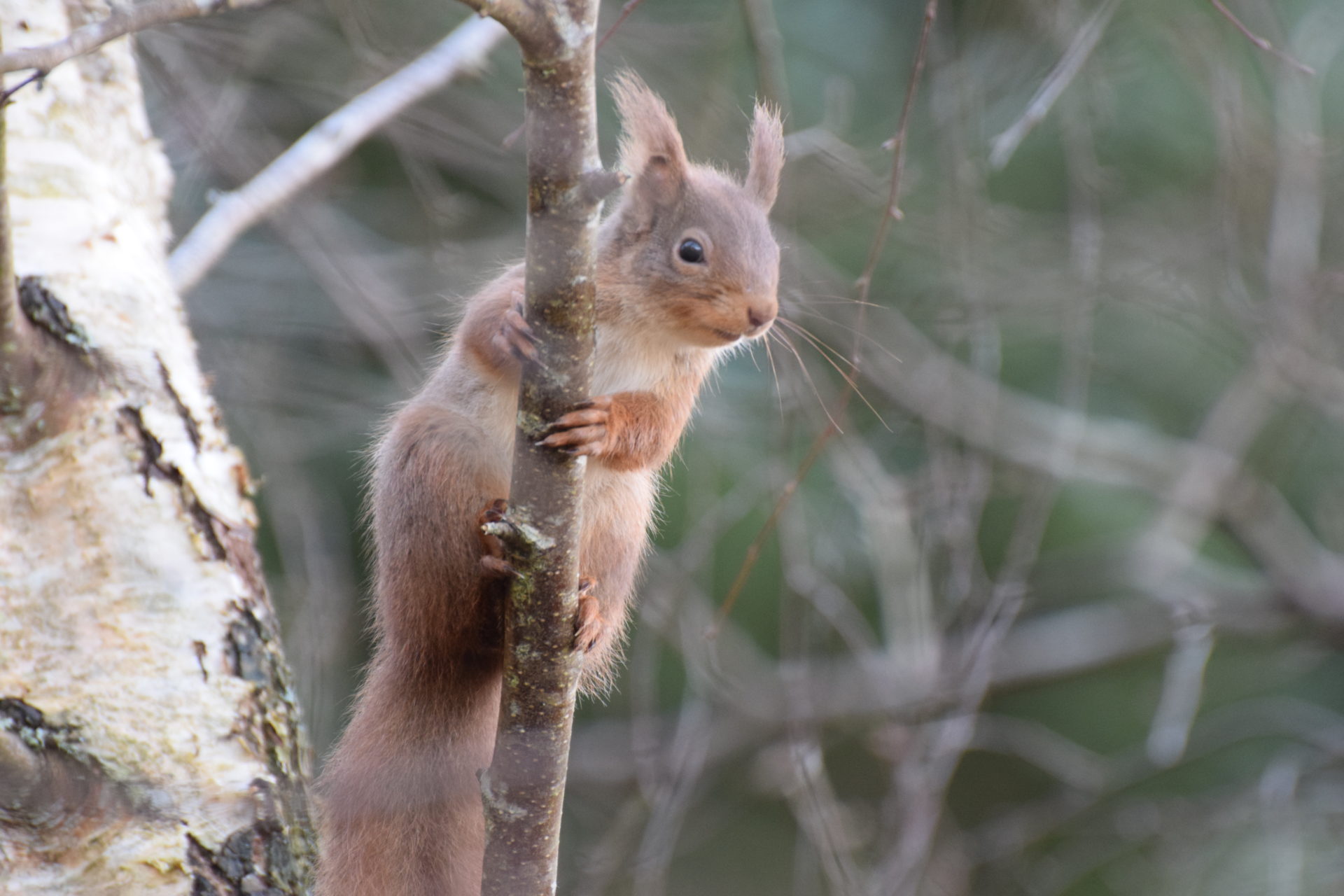
Red squirrel (photo thanks to Trini Graham-Stewart)
Graham-Stewart was backed by Charles Dutton, an independent woodland manager who is a director of the campaign group, European Squirrel Initiative. Dutton estimated that between five and 10 per cent of the red squirrel population in Scotland was killed every year by commercial tree felling.
“It is a scandal that a highly protected species is so persecuted,” he told The Ferret. “Economic timber harvesting interests are put ahead of wildlife planning, and it is this lack of joined up planning that is the real problem.”
The Scottish Wildlife Trust pointed out that red squirrels were a threatened species. “It’s vitally important that anyone who is carrying out forestry operations, or any other activities that could affect their habitat, follows the legislation and guidance that is designed to protect them,” said the trust’s conservation director, Sarah Robinson.
Forestry and Land Scotland said it provided annual licence returns to NatureScot. “We always comply fully with the terms and conditions of the licensing system and conduct our operations accordingly,” said an FLS spokesperson.
“Plantation habitats are hugely beneficial for red squirrels and we mark and retain drey trees in thinnings when we find them, though dreys are difficult to find and some may be lost during forest operations.”
FLS accepted there could be “a reduction” in squirrel numbers locally where trees are being felled. “Red squirrels are highly adept at moving to other parts of the forest and adapting to the changes that occur in a plantation forest over time,” said the spokesperson.
“The overall amount of suitable habitat for red squirrels on FLS land remains relatively constant, but its distribution varies in space and time as crops mature and others are felled.”
FLS maintained that at Balblair Wood “the survey was carried out to the standards required and using the appropriate techniques by a qualified member of staff”. There were “no sightings” of dreys, it said.
The FLS spokesperson added: “We have since taken steps to make improvements to our processes and procedures and to put in place additional guidance and training for new members of staff.”
NatureScot confirmed that it had received a complaint. “We immediately followed up these concerns with Forestry and Land Scotland which provided information on the measures in place to ensure activity was in line with licence conditions,” said the agency’s head of wildlife management, Donald Fraser.
“We take compliance issues seriously and it is helpful to have potential issues raised with us. We have been in contact with Forestry and Land Scotland to ensure that process and procedures are robust when any activities are undertaken under licensing provision.”
A spokesperson for Police Scotland said: “On Monday 10 January 2022, police received a report regarding concerns about red squirrel dreys and other nests in Balblair Wood, Invershin.
“We carried out enquiries with the relevant agencies and responded to the reporter. No further police action was required.”
Rob has more than 40 years’ experience specialising in reporting on environmental issues. He has co-authored three books about nuclear power, produced radio and television programmes. He likes muckraking.
The Ferret visited a Scottish golf course that's won plaudits for its eco-friendly management to learn about the relationship the industry can have with nature and the environment.
We asked about the environmental records of Scotland’s 25 best golf courses. The US president’s resort in the north east was the only one to breach its licence in recent years.
Climate change is causing rising sea levels and coastal erosion and 109 Scottish golf courses are at risk. We examined the issue as part of Green drive: Golf and the environmental crisis – a special Ferret series on golf and the environment.