We looked at inspection reports from the body which certifies “highest standard” farms with a public-facing ‘green tick’ — and found there have been breaches of its rules at dozens of fish farms.
Threats facing our mountains, forests and national parks are increasing, but the level of monitoring of our “protected sites” has almost halved in five years, Scottish Environment LINK has found.
The Scottish Government has been supportive of controversial green data centres and is liaising with the industry. But critics argue there are environmental considerations and companies must not be allowed to “write the rules”.
If it wasn’t for safer injecting sites I wouldn’t be alive today that’s for sure because I wouldn’t be able to stay alive long enough to hit bottom – to have a moment of clarity where I was able to say ‘I don’t want to do this any more’. “Trey Helton, manager of the Overdose Prevention Society in Vancouver
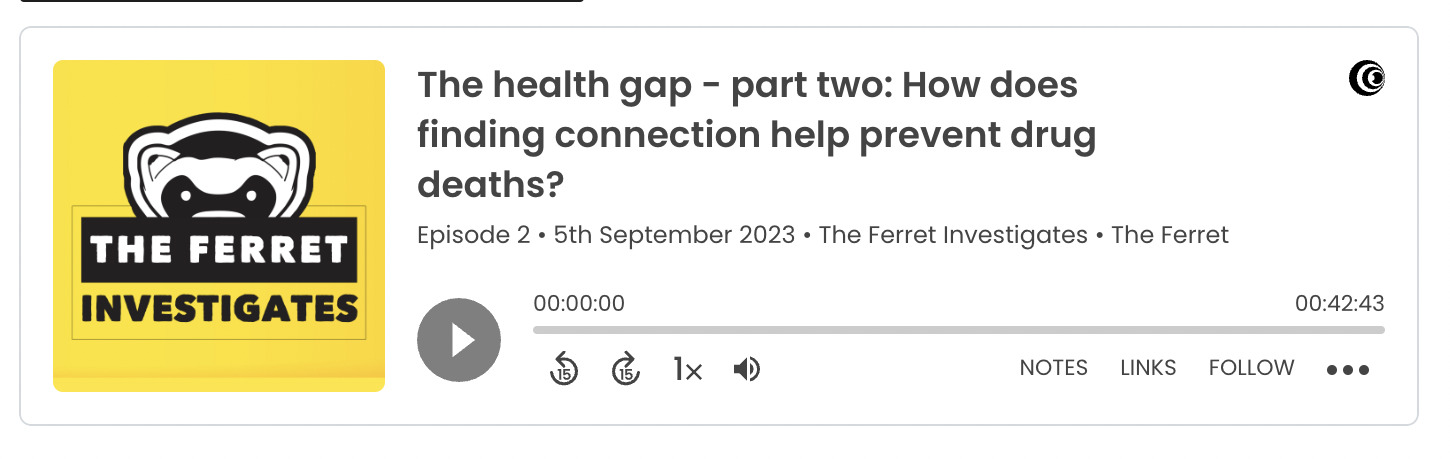
In part two of The Ferret investigates…the health gap – a three-part special podcast from The Ferret media co-op and Greater Govanhill magazine – we look at drug deaths, one of the key factors driving Scottish health inequalities.
In Scotland, men in the most deprived areas have a life expectancy of almost 14 years less than those in the most affluent areas. And for women that gap is ten and a half years.
A total of 1,051 people died of drug overdoses across Scotland in 2022 – that’s almost three people a day. And you’re 16 times as likely to die of a drug overdose if you live in a deprived community than if you live in a wealthy one.
In this episode we visit Simon Community Scotland‘s We See You project and hear from coordinator Jim Thomson and participant Owen Docherty about the power of finding connection.
We also visit Vancouver where Trey Helton tells us how the Overdose Prevention Society is saving lives… and explains how it’s helped the city’s most prolific cat burglar go legit.
We also hear from indigenous women at the Downtown Eastside Women’s Centre – a group disproportionately impacted by the opioid crisis there – about the colonial roots of the crisis and how reconnecting with their culture is helping them heal.
In the studio we hear from Simon Community Scotland’s Claire Longmuir and Professor Andrew McAuley from Glasgow Caledonian University about what’s working in Scotland and what more we need to do.
You can find all three episodes of The Ferret investigates…the health gap on The Ferret or wherever you get your podcasts.
Hosts: Karin Goodwin, of The Ferret and Samar Jamal, of Greater Govanhill magazine
Interviews: Karin Goodwin
Production: Halina Rifai and Karin Goodwin
Episode editing and sound: Halina Rifai
Music: Loris S. Sarid
Package about indigenous culture
Reporting, sound recording and writing: Karin Goodwin
Editing and sound design: Flora Zajicek
The Vancouver interviews were recorded on the territories of the Musqueam, Squamish and Tsleil Waututh Nations.
This article is part of our Mind the Health Gap project, funded by the European Journalism Centre, through the Solutions Journalism Accelerator – a fund supported by the Bill & Melinda Gates Foundation.
Only one in eleven major summer festivals analysed by The Ferret has a 50/50 gender split, with representation across all festivals declining at headline level.
Covert filming of farmed trout apparently suffering at an abattoir last year led to a firm being formally warned. New footage has prompted a fresh complaint.
Academics are raising concerns that an increasing percentage of young people, unable to cope with school, are withdrawing into their bedrooms, while families claim support is “woefully inadequate”.
We visited the Polish city of Krakow ahead of Holocaust Memorial Day which is held to remember the millions murdered by the Nazis – including six million Jews. Krakow's Jewish population was decimated then but the city is now home to one of the fastest-growing Jewish communities in the world.