Prospective MSPs are legally required to evidence their election spending and confirm the records are correct. Following an investigation by The Ferret, Police Scotland is examining whether nine Reform UK candidates failed to do so.
Dr Fiona Work, a former nurse, remembers December 2012 vividly. “I had gone to my friends and had a call saying that my house had gone under,” she says. “I had lived there for 25 years and there had never been flooding like that. I was out of my house for 10 months.”
Work lives in Edzell, a village in the north east of Scotland, which has fewer than 1000 residents. In 2012 it was hit by a flood that changed the village forever, affecting 44 properties, including Fiona Work’s house, and causing over £1m of damage. The Ferret talked to Dr Work about the flood group as part of a six country European investigation into both flood preparedness and recovery.
In the UK, our investigation looked at the effects of flooding in eastern Scotland, Norfolk and Greater Manchester, finding that many communities affected took a long time to recover and that it was not always clear who was responsible for flooding.
In Edzell, despite the collective trauma, the villagers decided to form a flood group just a month later, partly galvanised by Angus Council suggesting that the impact on Edzell had been minimal.
Work tells The Ferret: “They thought we had only suffered around £20,000 damage. We started to pull the figures apart and decided we wanted to work with the council.” Supported by the newly formed charitable organisation, the Scottish Flood Forum (SFF), the flood group started to work out what was needed so that Edzell would be far better prepared for flooding if it happened again. Work says: “I used learning about flooding as a catharsis, there were so few guidelines then about things like drying your house out at the right pace, reinstatement. The flood group offered emotional and physical support as well.”
Flooding in Edzell.
Eleven years later, when Storm Babet devastated eastern Scotland and Angus in particular, in October 2023, the village was ready. The actions they took saved the village from flooding and the group has been featured by the Scottish Environmental Protection Agency (Sepa) and the SFF as a model for community action. Work explains, “We follow the Sepa flood alerts and the core flood group makes decisions. When I knew it was going to hit, we made the call.”
Within 20 minutes the flood barriers had gone up and the team was consulting its flood maps. Edzell was divided into two zones. On the moor above the town there was an area that pools water. Work recalls: “We bagged it with sandbags to make a bund [a structure to contain liquids] to pool the water there. That saved the village. We were moving sandbags in wheelbarrows. I knew the bund would breach but it gave us time. We didn’t want it coming at us, fast and furious.”
The most challenging issue was that critical infrastructure failed. Edzell was completely cut off from outside assistance by road. Instead, Work and others checked on those who needed care, so nobody was left on their own.
Their model is a combination of actions – from drainage to barriers, including successfully working with the land owners Dalhousie Estate, to increase existing bunding (a way of retaining water with walls) to store water on Edzell Muir during high water, she explains. There is also more work going on with the council and the estate to see if holding more water back on the Muir could slow down the passage of water through the village.
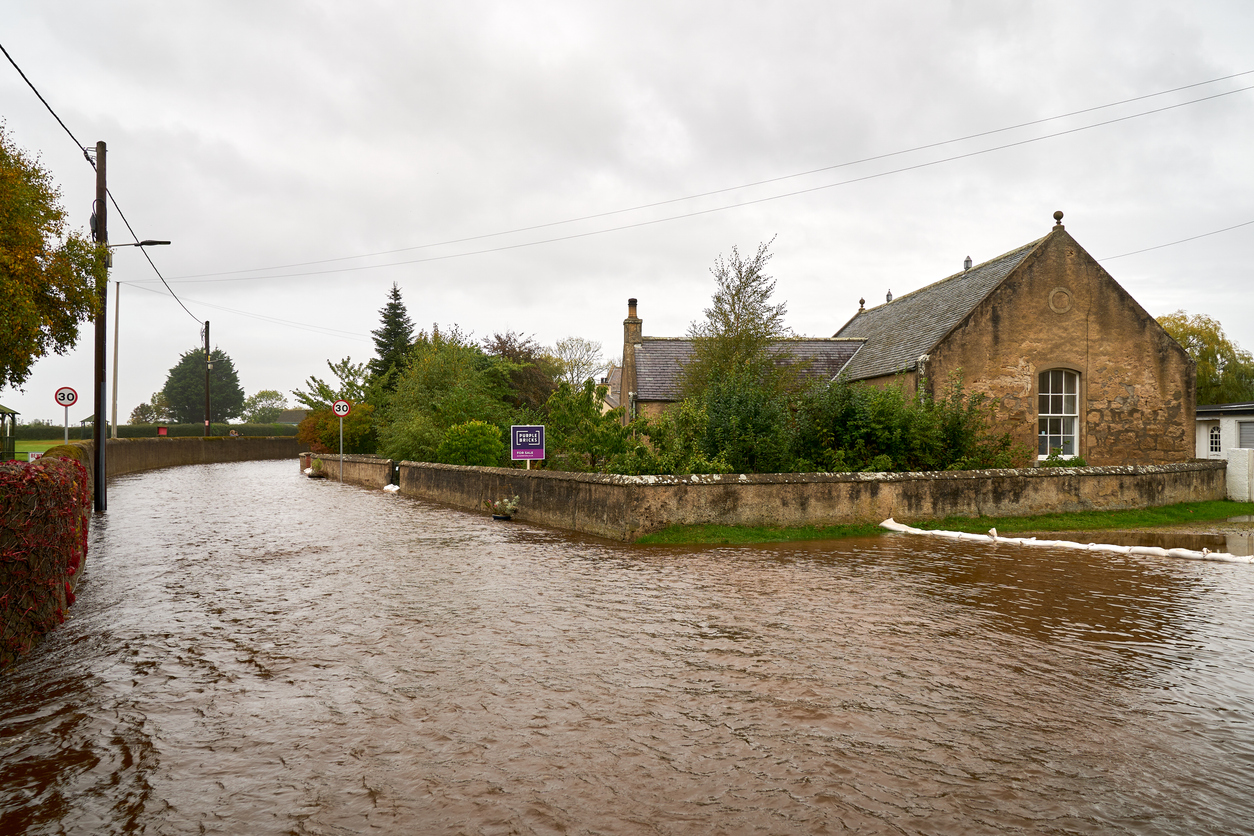
In parts of the North East, flooding has continued to have a devastating impact. Image from iStock/Brian Smith
Work emphasises that solutions are different for every place, because flooding can come from different issues, from drainage to rainfall. “We are still vulnerable if there is a flash flood,” she says “For instance, there aren’t any maps of the drainage here and the old roadmen who had that knowledge have died. But a lot that we have learned has come from older people in the village.”
Fiona Work says it’s about not asking anyone to do too much. “We ask everyone to do just one thing. We’ve now got our resilience centre, we have heaters, a generator. The knitting group made blankets. We have got phone chargers, lights, cooking facilities. The men in sheds group have been great.”
“We need to measure and monitor the effectiveness of natural flood management interventions really well.”
Larissa Naylor, professor of geomorphology and environmental geography at the University of Glasgow.
There are many solutions being suggested at the moment by the Scottish government and other institutions further afield. Other funded projects include a school with a sustainable urban drainage system; other projects to slow down rivers in spate through rewinding and storage, to community volunteers monitoring coastal change.
Staff members of the Scottish Flood Forum, some of whom have been affected by flooding themselves, are also key to communicating the different tools and solutions that can make a difference before, during and after a flood event. On a call with The Ferret, they talk through all the measures they suggest. SFF has flood officers that support places like Brechin after flooding, and their work can continue for years after an event. The charity, along with Flood Re, a specialist initiative between government and insurers so that those flooded can obtain more affordable insurance after an event, also support Flo, the flood bus, which travels around Scotland, showing some of the advice and measures households can take to build flood resilience.
Although experts explain that hard defences against flooding and coastal erosion still have a major place in protection, other measures are also seen as part of a suite of solutions, none enough of their own but all of which can help. They include what is called property flood resilience, where dwellings are designed or rebuilt to recover from flooding more quickly, with sockets higher up, different flooring and kitchen cupboard materials, to ensure that valuables are kept in grab bags as high up as possible. New build developments include sustainable drainage systems to store water, some with permeable road surfaces so it soaks through, rather than runs off.
Natural flood management techniques are seen as key too although Larissa Naylor, professor of geomorphology and environmental geography at the University of Glasgow, warns that no one solution is a panacea. “We need to measure and monitor the effectiveness of natural flood management interventions really well. The scale at which we might need to do them..might not be politically or socially or economically viable…that doesn’t mean they don’t work, but it’s how many you will need.” It is, as she warns, key to fund measures properly.
Carol Raeburn, from the Scottish Flood Forum, also urges that we end building on flood plains, allow more space for water, and give communities at risk of flooding lasting support. She says, “It has to be a suite of options.” There may be no one solution but none will work without community – and that is what Edzell village showed in 2023.
This project, After The Floods, is part of a six country European investigation, looking at how communities weather flooding – and how authorities are meeting the challenge of rising floodwaters and increasing coastal erosion. The production of this investigation was supported by a grant from the Investigative Journalism for Europe (IJ4EU) fund.
Featured photo iStock/moonmeister
Photos courtesy of Katharine Quarmby and Edzell Flood Group.
Billy is a founder and co-editor of The Ferret. He's reported internationally and from Scotland, and focuses on far right extremism, human rights, animal welfare, and the arms trade. Likes longform storytelling and photography.
This summer we revealed that convicted loyalists from Belfast travelled to Glasgow for a far right protest. Further digging has unearthed a rapidly expanding anti-immigration network between Scotland and Northern Ireland.
Only one in eleven major summer festivals analysed by The Ferret has a 50/50 gender split, with representation across all festivals declining at headline level.
Academics are raising concerns that an increasing percentage of young people, unable to cope with school, are withdrawing into their bedrooms, while families claim support is “woefully inadequate”.
The tiny Danish island of Bornholm was the site of one of the world’s first offshore wind turbines back in the 1940s. Now its citizens are fighting to build one of the largest community wind farms ever, and raise the benchmark of what’s possible for locally owned energy.