New allegations at Stirling Castle dating back eight years have emerged following a string of complaints about its custodians, Historic Environment Scotland, in recent months.
Sharia law is a contentious issue in the UK. Some question whether it is compatible with so-called British values while claiming it's a separate legal system operating parallel to UK laws. In our latest De-noiser, we look at the facts.
Sir Peter Mathieson appears to have confirmed he is being paid for a board role at a university spin-off at the same time as many staff face uncertainty about their futures.
John Swinney defended the Scottish Government’s record on justice during first minister’s questions (FMQs) on October 26, claiming crime was at an all-time low.
During questioning from Douglas Ross, appearing at his last FMQs as leader of the Scottish Conservatives, Swinney said he must “put on the record” that “levels of crime in Scotland are currently at 40-year lows”.
CLAIM: “Levels of crime in Scotland are currently at 40-year lows”.
Levels of crime in Scotland are currently at 40-year lows.
Swinney’s claim came after criticism from Douglas Ross about the level of support the Scottish Government has given Police Scotland and the number of officers in post. Swinney accepted that police numbers have fallen – the latest figures show full-time equivalent roles have decreased by 392 in the last 12 months – but said crime levels were at 40-year lows.
When people talk about crime levels in Scotland, they usually refer to recorded crime. This covers all crimes recorded by the police, not the number of convictions or sentences for crimes. It also will not cover all the crimes committed as many are never reported to the police.
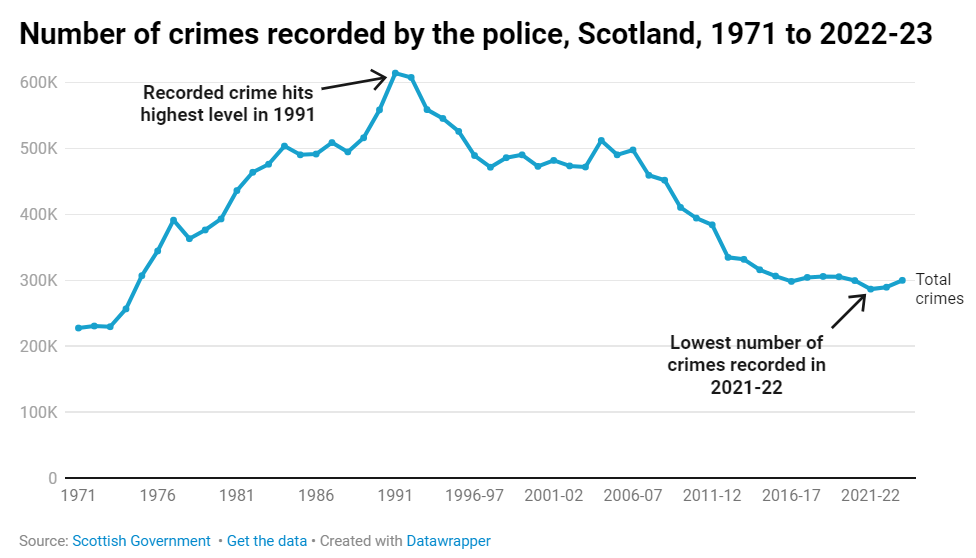
In 2023-24, 299,780 crimes were recorded in Scotland. This is higher than the previous year, 2022-23, when police recorded 289,362 crimes, and in 2021-22, when there were 286,464 crimes recorded.
This final figure was the lowest number recorded since 1974. Back then 256,498 were documented.
Total recorded crime gives you an indication of overall levels of crime, but to compare the level of crime to the relative population, we can look at crime rates per 100,000 population in Scotland.
The latest crime rate for 2023-24 was 550 per 100,000 people. This was higher than the previous three years but less than half the rate when it peaked in the early 1990s.
What’s behind the recent increase?
Overall levels of recorded crime have reduced gradually in recent decades, after reaching a peak of 613,943 in 1991.
There was a consistent year-on-year reduction between 2006-07 and 2016-17, then a small increase until the first year of the Covid-19 pandemic in 2020 which correlated with a drop of more than 5,000. Since 2021-22 rates have gradually begun to increase again.
There have been increases in non-sexual crimes of violence, which include crimes such as assault and robbery. They are at their highest rate since 2011-12. However, serious assaults and attempted murders have reduced to their lowest level since 2014-15.
Sexual crimes have reduced over the past two years, after reaching a high in 2021-22 of 15,049. Changes to legislation and procedure have impacted trends in recorded sexual crime, as well as improvements in historical reporting of crime.
Ferret Fact Service verdict: Mostly False
It is misleading to say that levels of crime in Scotland are currently at 40-year lows. While levels of overall recorded crime and the crime rate per 100,000 are lower than 40 years ago, both have increased over the last few years.
Political parties have accepted thousands of pounds from lobbyists in recent years. Anti-corruption campaigners claimed donations buy lobby firms “privileged access” to politicians for their wealthy clients.