We asked about the environmental records of Scotland’s 25 best golf courses. The US president’s resort in the north east was the only one to breach its licence in recent years.
Climate change is causing rising sea levels and coastal erosion and 109 Scottish golf courses are at risk. We examined the issue as part of Green drive: Golf and the environmental crisis – a special Ferret series on golf and the environment.
Scotland is facing a once-in-a-generation shift. For more than half a century, oil – the country’s ‘black gold’ – provided jobs and prosperity, sustaining tens of thousands of workers and shaping whole communities.
Now North Sea production is in decline as reserves become harder and more expensive to reach. At the same time, the UK has restricted new exploration to help phase out fossil fuels and meet climate goals.
This double pressure – the geological reality of dwindling reserves and the political commitment to tackle climate change – means a profound transformation is underway.
Yet oil and gas still supply most of Scotland’s energy, and around four per cent of Scottish jobs are in some way tied to the industry.
Moving away from fossil fuels will change not only how we power our homes and travel, but also how thousands of families make their living.
Politicians insist this can be a “just transition” – that workers and communities will not be abandoned, and that secure, green jobs will replace those lost. The devastation inflicted by deindustrialisation in the 1980s can be avoided, they claim.
But is their rhetoric being matched by reality? This weekend The Ferret is launching a new six-month long investigation, After Oil, which will examine the truth behind the “just transition” to clean energy in the run-up to next year’s Holyrood election.
With energy set to be a key pillar of the campaign, our reporting will look beyond the slogans to ask who is winning, who is losing, and how fair the transition really is.
Already there are warning signs. Unions point to industrial closures and the loss of thousands of North Sea jobs as evidence that employment is disappearing faster than it can be replaced.
These setbacks have created space for opportunistic politics. Populist figures have blamed climate policy for job losses and argued the remedy is scrapping net zero. While they oversimplify a complex picture, their messages are gainingtraction and show those who believe in the transition can afford few further missteps.
Instead of looking for easy answers, After Oil will follow the money behind the transition, interrogate official plans, and ask tough questions of those with power.
As well as looking at the way old industries are being wound down, we’ll also examine how the roll-out of renewables is creating tensions.
Scotland’s impressive deployment of wind power has largely been powered by international supply chains, with few parts built here, and locals seeing a “measly” financial return. Rural communities are asked to accept vast new energy infrastructure on their doorstep without feeling they have a genuine say in where it goes or who profits.
But we want to tell positive stories about the transition too. We’ll report on projects that are making a difference here in Scotland and in other parts of the world, and examine how we can learn lessons from history.
We’re launching After Oil this Sunday with an in-depth look at the closure of the Grangemouth oil refinery – a ‘litmus test’ of the just transition which locals say has been catastrophically failed.
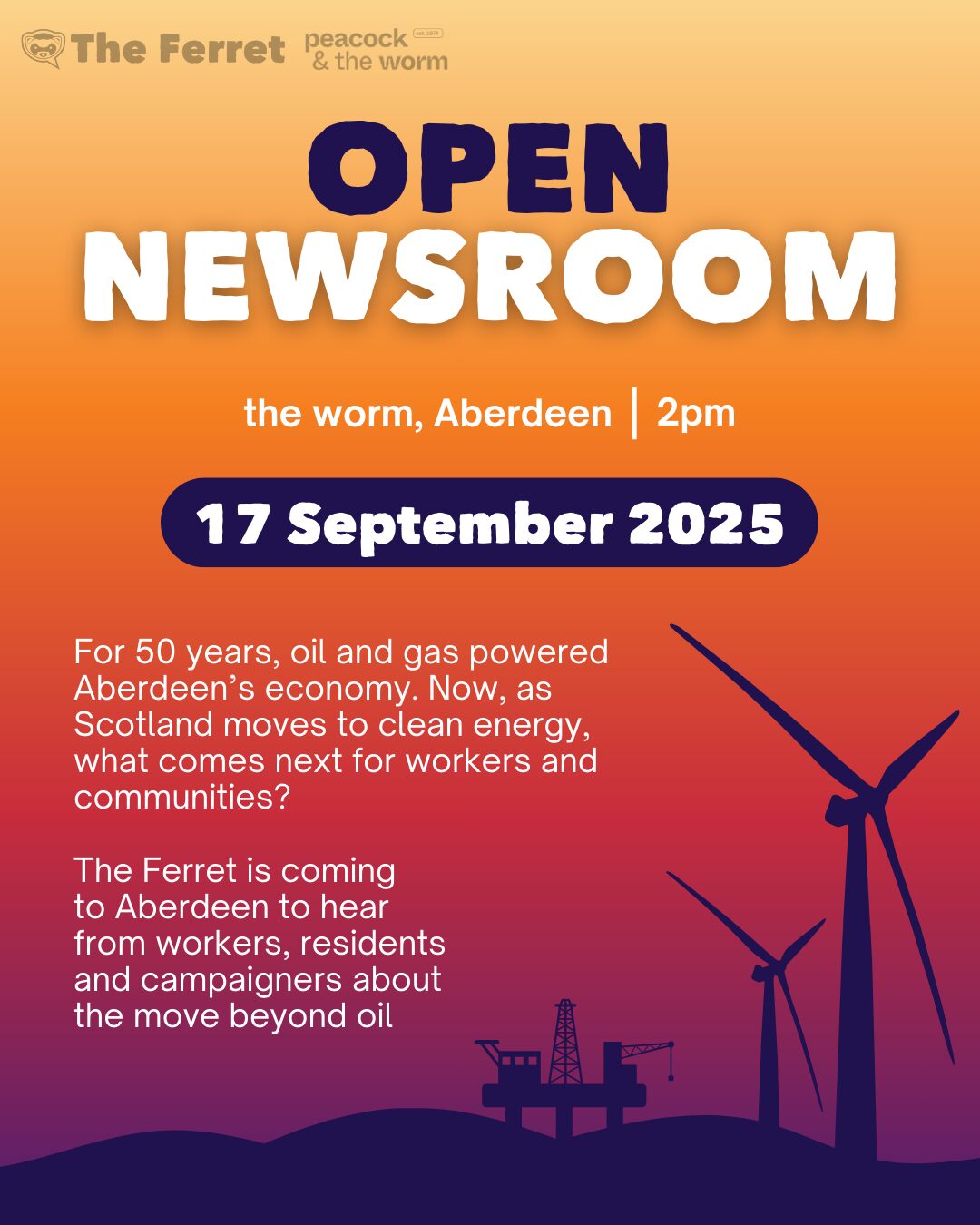
In coming months we’ll move our attention to Aberdeen and the North Sea, holding our first ‘Open Newsroom’ event outside Glasgow and inviting those with something to say to feed into our editorial plans. We’re going to visit the Highlands and Islands too with more events to be announced soon.
In this series we want to hear from you as we raise questions about who really controls the transition and whether the benefits of new energy will really be felt here in Scotland.
Let us know what you think of our first piece this Sunday – published in partnership with the Sunday National – and sign-up to our free newsletter to make sure you don’t miss our coverage.
Karin is The Ferret’s co-editor and has reported on people, power and planet for the UK’s leading outlets. She co-founded our Community Newsroom in Glasgow and is interested in participatory approaches to journalism. Audio is her favourite medium.
Paul is an investigative journalist with a focus on the environment, energy and climate change. His work has been featured by Channel 4 News and the UK’s leading newspapers. When not Ferreting he can be found walking and listening to podcasts.
We asked about the environmental records of Scotland’s 25 best golf courses. The US president’s resort in the north east was the only one to breach its licence in recent years.
Climate change is causing rising sea levels and coastal erosion and 109 Scottish golf courses are at risk. We examined the issue as part of Green drive: Golf and the environmental crisis – a special Ferret series on golf and the environment.
Huge volumes of sewage sludge have been used to fertilise Scottish farmland. Studies show it contains microplastics, forever chemicals and cancer-linked pollutants.