

Highland trout firm accused of animal welfare abuses
Covert filming of farmed trout apparently suffering at an abattoir last year led to a firm being formally warned. New footage has prompted a fresh complaint.
Covert filming of farmed trout apparently suffering at an abattoir last year led to a firm being formally warned. New footage has prompted a fresh complaint.

Those bereaved by suicide have a 65 per cent increased risk of taking their own lives. So why is there not more funding for support after tragedy strikes?

The Scottish Government says the move was needed to tackle the "burden" caused by the growth in AI-assisted objections to energy projects. Critics say it is a way to mute public opposition.


Five local newspapers in Scotland have refused to publish an advert backed by 26 environmental and community groups criticising the salmon farming industry.
Campaigners have accused the newspapers of “blatant censorship” and of forming an “unholy alliance” with multinational salmon companies. The papers often ignored the “environmental havoc” caused by salmon farming, they claimed.
The newspapers’ publisher said it had a right to decline any advert but did not explain its reasons. The salmon farming industry described the advert as “garbage” and praised papers for not publishing it.
The advert questioned the sustainability of salmon farming and urged consumers not to buy farmed fish. It posed six questions about pollution, pesticides, diseases, the impact on wild salmon, the sources of fish feed and the use of lice-eating fish.
The industry was responsible for the “severe degradation” of parts of Scotland’s coastal environment, the advert said. “Where in the world has sustainable salmon farming actually been achieved?” it asked.
All too often west highland and island papers turn a blind eye to the environmental havoc caused by salmon farming.
Andrew Graham-Stewart, Salmon and Trout Conservation Scotland
The advert was rejected by Wyvex Media, a company based in Oban that publishes five west coast papers: Oban Times, Lochaber Times, Campbeltown Courier, Argyllshire Advertiser and Arran Banner.
According to campaigners, full page adverts were booked for “close to £2,000” to run in the five papers at the end of May. But they were withdrawn at the last minute following a decision understood to have been taken at “director level”.
Wyvex also publishes the trade magazine Fish Farmer “for all the latest industry news, markets and jobs in aquaculture”. The magazine’s editorial advisory board includes leading figures from the salmon farming industry.
The advert was run by the Stornoway Gazette on 26 May and the Daily Record on 28 May. The West Highland Free Press asked for the text to be changed to remove a reference to the Scottish Government minister, Mairi Gougeon, but this was rejected by campaigners.
Among the 26 organisations backing the advert were community groups from the west of Scotland, Scottish Creel Fishermen’s Association, Compassion in World Farming, Open Seas, Sea Shepherd and the outdoor clothing retailer, Patagonia.
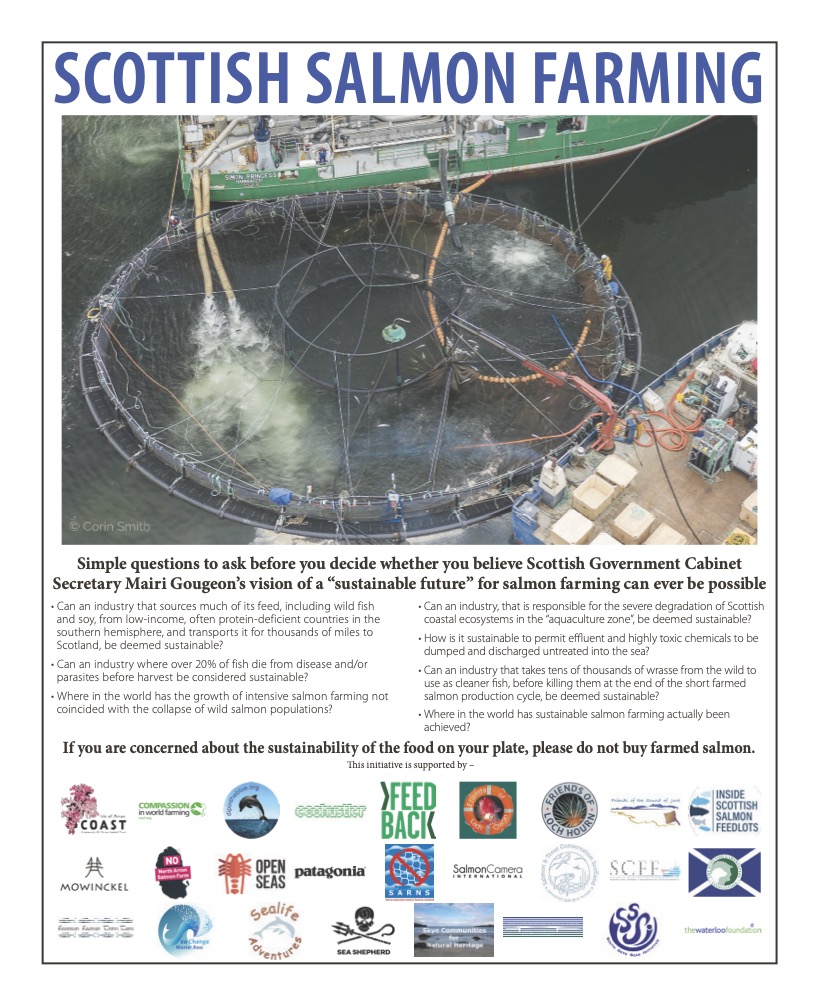
The advert was co-ordinated by Andrew Graham-Stewart, the director of the wild fish group, Salmon and Trout Conservation Scotland. “All too often west highland and island papers turn a blind eye to the environmental havoc caused by salmon farming,” he said.
“They bend over backwards to give space to the industry and its relentless propaganda. There appears to be an unholy alliance.”
Graham-Stewart alleged that industry critics were regularly denied a platform. “Now even our paid-for advertising is being rejected,” he told The Ferret.
“This amounts to flagrant and partisan censorship, particularly as some of these regional papers have a virtual monopoly.”
Howard Wood, who co-founded the Community of Arran Seabed Trust, the Sustainable Inshore Fisheries Trust and the Coastal Communities Network, stressed the importance of holding ministers to account.
“If Scotland is to have any chance of reversing wild salmon and sea trout declines and halting the pollution of our marine ecosystems, then it is vital that informed debate and information dissemination by community organisations is not threatened by blatant censorship by owners of local papers,” he said.
“Such practice is extremely worrying, something more akin to Putin’s Russia or China.”
Andrew Holder and Maggie Brotherston from the Friends of Loch Creran warned that free speech in the west of Scotland was “dead in the water” like so many farmed fish. “We are shocked and outraged at the decision of Wvvex Media to censor images and opinions highlighting Scotland’s dirty fish farming industry,” they said.
Wyvex Media did not respond to The Ferret’s requests to comment. In an email to Graham-Stewart on 25 May, the company’s advertising sales director, Nicky Murphy, said: “Whilst I understand that this is a frustration for you, as you will appreciate we reserve the right as a publisher to decline any advert.”
The West Highland Free Press confirmed that its advertising team had “concerns” that a section of the advert would not comply with the Advertising Standards Authority code.
“I understand the group indicated it was not willing to review this section of the advert to reflect these concerns, so they then withdrew it — as was their right,” said the paper’s editor, Keith MacKenzie.
“As far as editorial coverage goes, the Free Press regularly features the opinions of those who oppose salmon farming, as well as those who support it.”
The Scottish Government promised to publish its vision for sustainable aquaculture “by the end of the year”, saying it will have “enhanced emphasis on environmental protection and community benefit at its core”.
A government spokesperson said: “Aquaculture is a significant contributor to our rural economy, providing well paid jobs in some of Scotland’s most fragile communities and will play a major role in our green recovery and transition to net zero.
“All types of development have interactions with the environment and it is important that they are managed within environmental limits and ensure there is a thriving marine ecosystem for future generations.”
A spokesperson for the industry body, Salmon Scotland, said: “This advert is the type of garbage that appears in The Ferret week in week out and includes a personal attack on a Scottish minister, so it’s good that local newspapers had the sense not to publish it.”
Photo Credit: iStock/MariusLtu


Covert filming of farmed trout apparently suffering at an abattoir last year led to a firm being formally warned. New footage has prompted a fresh complaint.

The Scottish Government says the move was needed to tackle the "burden" caused by the growth in AI-assisted objections to energy projects. Critics say it is a way to mute public opposition.

An investment vehicle managed by JP Morgan and state-backed firms from France, Norway and China own Scottish wind farms which have paid tens of millions in dividends this decade.

Thousands of species rely on Scotland’s indigenous trees to survive. In our public woodlands, they’re vastly outnumbered by non-native timber plantations.
